Jose AI, AI Operations Assistant (Investor MVP)
.svg)
Product Designer
.svg)
2 Product Designers, 1 Graphic Designer, 1 Marketer
.svg)
2 weeks (MVP sprint)
.svg)
Tablet-based app
.svg)
In development (MVP scope complete)
DESCRIPTION
For non-technical restaurant operators, Jose turns sales, labor, and inventory data into plain-language, actionable guidance so decisions happen fast without dashboards.
View Jose AICONSTRAINTS
- 2-week timebox, MVP scope only, investor-demo ready
- Tablet-first layout and density requirements
- Insights had to be understandable without exposing “raw analytics” complexity
DELIVERABLES
- Core workflows delivered: Budgeting, Profit check, Add expenses
- UI system delivered
- Build-ready handoff: production-ready design assets prepared under a 2-week sprint.
Problem Framing
CONTEXT

SCALEDai was preparing an investor-facing MVP for José, an AI operations assistant designed to help small restaurant owners make faster financial decisions.
Problem

Although the team had research identifying pain points in restaurant operations, these insights had not yet been translated into a usable product.
Most operators lacked time and technical knowledge to interpret analytics-heavy dashboards.
Most operators lacked time and technical knowledge to interpret analytics-heavy dashboards.
Design Challenge

Design an MVP that turns raw operational data into clear, plain-language guidance so restaurant owners can quickly understand their numbers and act on them.
Key decisions
Chose guided conversations over dashboards
Why
Dashboards raised cognitive load for this audience; guided flow kept momentum and clarity.
What I delivered
Conversation-first entry point that routes users from question to action instead of navigation-first exploration.
Trade-off accepted
Reduced ability for experienced operators to scan and monitor multiple metrics simultaneously in exchange for faster first-time comprehension, lower language dependency, and higher trust at entry.

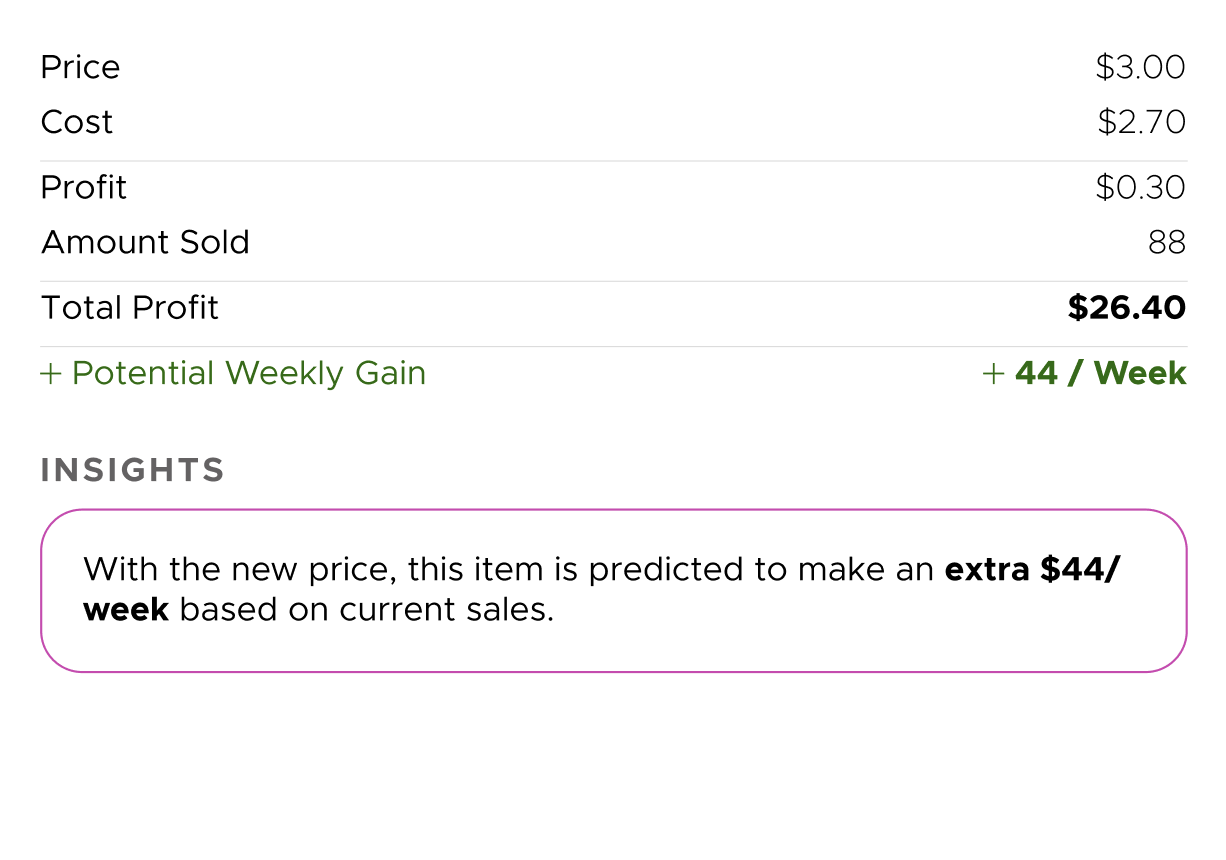
Designed recommendations to be directly actionable
Why
Insights only matter when they lead to a decision in the same moment, in the same place.
What I delivered
Recommendations paired with immediate financial impact + inline rationale (the “why” behind the number).
Trade-off accepted
Reduced transparency into underlying reasoning and model nuance in exchange for faster decision-making and lower cognitive effort at the point of action.
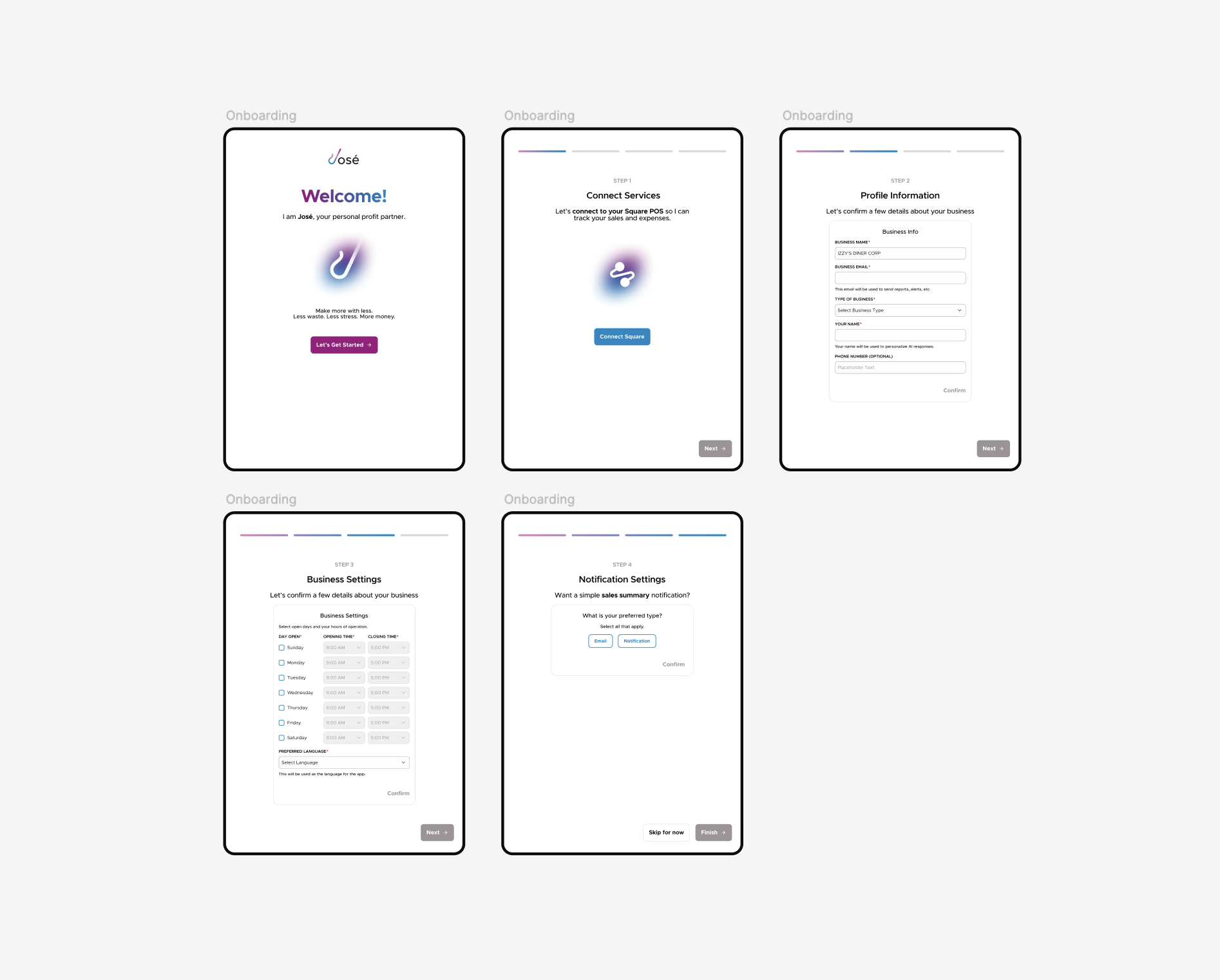
Used “progressive commitment” onboarding to remove early friction
Why
Value-first connection before deeper config reduces early overwhelm while still capturing minimum info needed for personalization.
What I delivered
Sequenced onboarding that prioritizes quick value before full setup.
Trade-off accepted
Slower initial setup and higher upfront effort in exchange for higher data quality, more reliable insights, and reduced misinterpretation downstream.

Put trust explanations beside outputs (not buried elsewhere)
Why
Trust increases when recommendations include plain-language explanation, not when they look “smart.”
What I delivered
Contextual “why” explanations (tooltips/modals) beside budget recommendations and guidance.
Trade-off accepted
Increased visual density and potential cognitive noise in exchange for immediate confidence in system outputs and reduced need to search for explanations elsewhere.
Defined edge cases early to protect demo flow and reduce ambiguity
Why
Demo risk spikes when empty states and errors are hand-waved.
What I delivered
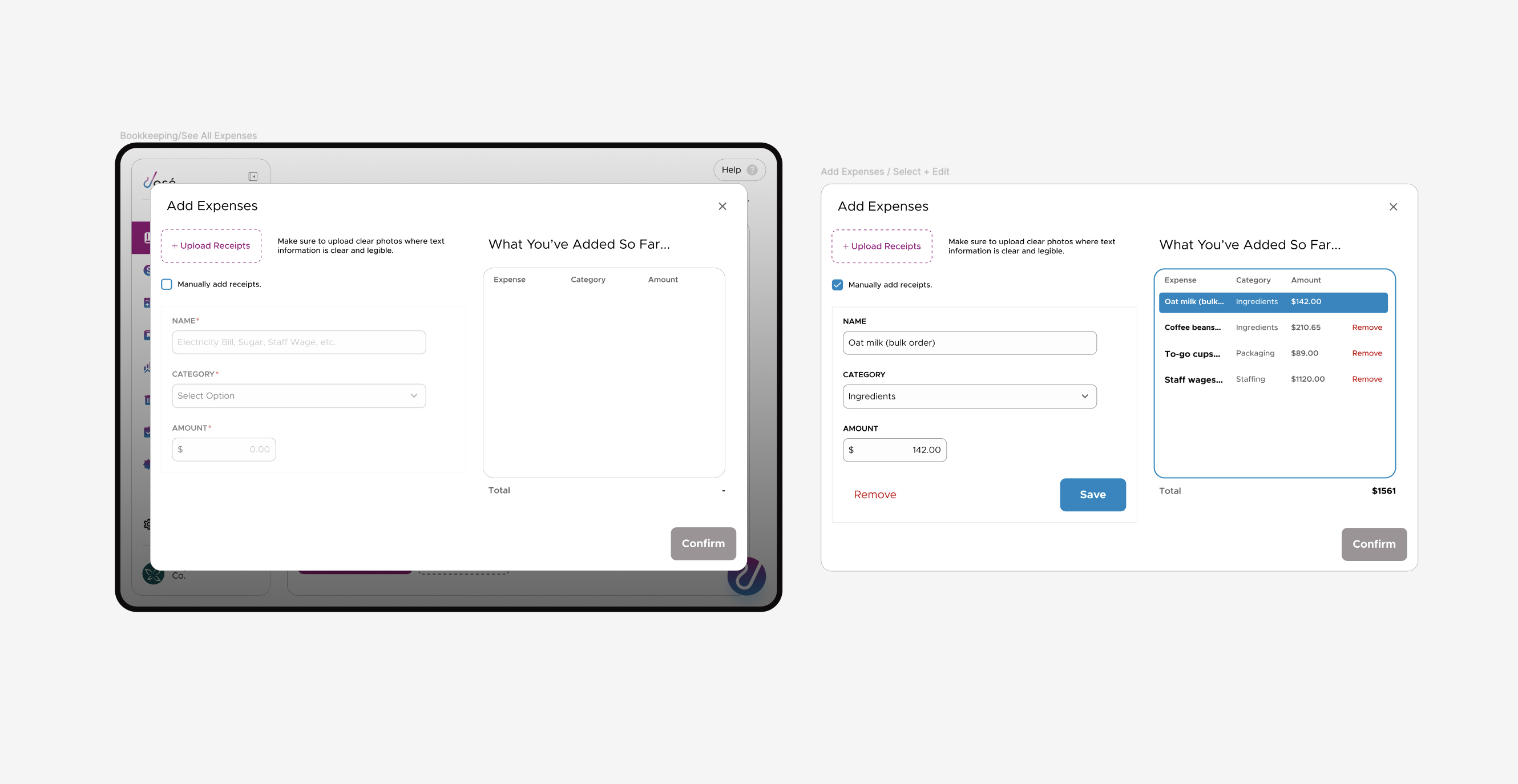
Empty notifications state, “no upcoming budget” state, and upload vs manual receipt paths.
Trade-off accepted
We sacrificed extensibility to guarantee reliability at MVP stage.


Kept navigation persistent to support “operator scanning” behavior
Why
Operators bounce between categories; persistent nav reduces re-orientation cost.
What I delivered
Left sidebar as the stable mental model across Bookkeeping, Profit, Budgeting, Inventory, Sales.
Trade-off accepted
Reduced single-task focus and increased on-screen elements in exchange for faster task switching and lower re-orientation cost for operators.
build-ready artifacts
Flow map + decision gates

Chat interaction box pattern
Sidebar navigation pattern

Modal pattern

Insights & Alert blocks

Profit Modal States

Budgeting States

Expenses States
The outcome
5-second comprehension testing with 10 participants

6/10
Identified the financial function.
4/10
Anchored to the voice UI and misread the product as a recording or communication tool. See Next Steps.
Live MVP Demonstration
The José AI prototype was deployed as a publicly accessible web experience, allowing stakeholders and investors to interact with the product and understand its core value in a real-world context.
KDays Public Demo
Shown in a real public demo context at KDays 2025 (proof the team was confident enough to present).

Next steps
If I had 1–2 more sprints...
.svg)
Revisit conversational screen hierarchy to lead with financial context before presenting input modality. The 4/10 misread as a communication tool is a concern. Instead of input type, maybe quick access to core functionalities such as profit trackers or inventory checks would read as "AI business tool".
Add instrumentation: track prompt-to-action completion and modal drop-off during budgeting/profit flows.
Expand edge cases: error handling for receipt upload/OCR and partial data availability.
Validate comprehension: quick usability test on “Why” explanations and insight wording.
